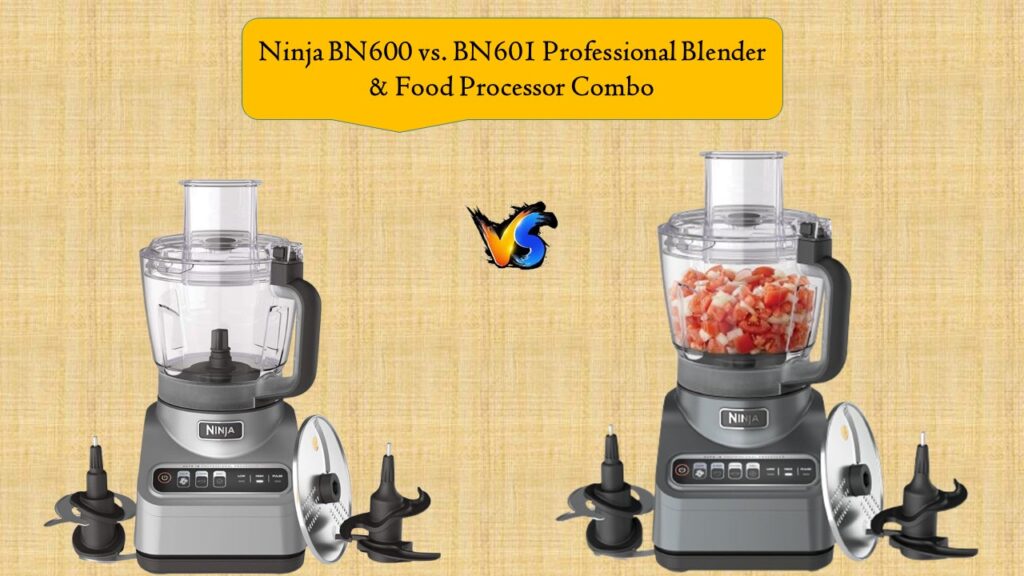
Choosing between the Ninja BN600 and the BN601 is a bit like choosing between a high-end sports sedan and the “performance pack” version of that same car. They look almost identical as they sit on the shelf, sporting that familiar Ninja silver and a sturdy 9-cup bowl. However, the real story unfolds when you actually lock the bowl into place and try to knead two pounds of heavy pizza dough.
I’ve spent the last month treating my kitchen like a commercial test lab. I’ve pulsed through endless cloves of garlic, shredded blocks of sharp cheddar until my hands were tired, and pushed both motors to their thermal limits. What I discovered is that while both machines carry the “Professional” badge, the transition from the 850-watt BN600 to the 1000-watt BN601 represents a significant shift in how Ninja handles “peak torque.”
If you are currently staring at these two models online, wondering if those extra 150 watts and a slightly different button layout actually matter in the middle of a Tuesday night dinner rush, let’s get into the mechanical weeds.
The Key Difference: Peak Power and Program Logic – Ninja BN600 vs. BN601
The primary distinction between these two models comes down to Raw Wattage and the Intelligence of the Auto-iQ programs.
- The Ninja BN601 (Professional Plus) is the beefed-up successor. It features a 1000-peak-watt motor and four Auto-iQ programs (Chop, Slice, Puree, and Dough). It is designed to be a more comprehensive “all-rounder” for the modern kitchen.
- The Ninja BN600 (Professional) is the slightly more compact, 850-watt It features three Auto-iQ programs. While it is technically the “base” model, it is often praised for its high torque-to-size ratio, though it lacks the dedicated “Puree” intelligence found in the newer 601.
Essentially, the BN601 is faster and “smarter” for liquid-heavy tasks (like hummus or sauces), while the BN600 is a straightforward chopping and dough-folding workhorse.
Comparison Table: Ninja BN600 vs. BN601 Professional Food Processor
| Feature | Ninja BN600 (Professional) | Ninja BN601 (Professional Plus) |
| Peak Power | 850 Watts | 1000 Watts |
| Bowl Capacity | 9 Cups | 9 Cups |
| Auto-iQ Programs | 3 (Chop, Shred, Dough) | 4 (Chop, Slice, Puree, Dough) |
| Dough Capacity | 2 lbs in 30 seconds | 2 lbs in 30 seconds |
| Dimensions (HxWxD) | 15.5″ x 9.8″ x 7.3″ | 16.02″ x 9.8″ x 7.7″ |
| Blade Material | Stainless Steel | Stainless Steel |
| Color | Silver / Black | Silver / Black |
| Safety Features | Interlock Lid System | Interlock Lid System |
| View Current Price on Amazon | View on Amazon | View on Amazon |
Detailed Comparative Review: My Life in the Kitchen
Design: A Tale of Inches and Accents
When I first lined these two up on my granite counter, the size difference was the first thing I noticed. The BN601 is slightly taller – about half an inch – and feels a bit “girthier” in the base. This is likely to house the larger 1000-watt motor assembly. In a tight kitchen, half an inch doesn’t sound like much, but if you have low cabinets, the BN601 might require you to pull it forward just to get the lid off.
The BN600 has a slightly more “compact” feel. The silver finish on both is high-quality plastic that mimics brushed aluminum, but I noticed the BN601’s control panel is a bit more refined. The buttons are more flush with the surface, which, as I found out after an accidental flour spill, makes it much easier to wipe down.
Ease of Use: The “Pusher” Experience
Both machines use a standard feed chute and pusher, but the BN601 felt a bit more stable when I was feeding in heavy carrots. With the BN600, I noticed a slight vibration in the bowl when the 850-watt motor really ramped up to meet the resistance of the vegetables.
The assembly on both is remarkably intuitive. Unlike older food processors where you have to twist the bowl and then twist the lid and then pray to the kitchen gods that the safety pin aligns, these Ninja models use a “drop-and-click” system. If the handle isn’t locked, the light flashes, and it won’t start. It’s “toddler-proof” and, more importantly, “pre-coffee-human-proof.”
Functions: The Puree Test
This is where the BN601 justified its “Plus” title for me. I made a batch of hummus in both.
- The BN600: I had to use the “Chop” setting and then manually hold the “High” button to get the chickpeas down to a smooth consistency. It took about two minutes of manual pulse-management to get it right.
- The BN601: I hit the “Puree” button and walked away to rinse the tahini jar. The Auto-iQ program knows exactly when to pulse to let the ingredients drop back onto the blades and when to spin at high RPMs to emulsify. The result was noticeably creamier.
For dough, however, it was a dead heat. I threw 2 lbs of pizza dough into both. Both machines managed to form a cohesive ball in exactly 30 seconds without the motor smelling like it was struggling. If you only make dough, the extra 150 watts of the 601 are a luxury, not a necessity.

Ninja BN600 Professional Food Processor (Renewed)
- The Ninja Professional Food Processor with dough blade makes food prep easier with its power, intelligence, and versatility. Preset programs chop veggies, shred cheese, and makes cookie dough from scratch—all at the touch of a button.
- 850 Watts: The most powerful kitchen food processor (under $200)* can process the toughest ingredients with ease. (*based on average selling price and rated wattage)

Ninja Professional Plus Food Processor, 1000PW, 9-Cup, Grey, BN601
- POWERFUL PERFORMANCE: Equipped with a 1000-peak-watt motor, this Ninja food processor effortlessly handles tough ingredients, ensuring smooth and consistent results every time.
- AUTO-IQ TECHNOLOGY: Features 4 Auto-iQ intelligent preset programs that take the guesswork out of food prep, providing one-touch control for chopping, slicing, pureeing, and dough making.
| Performance Metric | BN600 (850W) | BN601 (1000W) |
| Onion Chop | Consistent, but watch for mush. | Very precise; clean edges. |
| Celery Slicing | Good; occasional “tail” left. | Excellent; uniform thickness. |
| Nut Butter | Gets warm; takes effort. | Handles heat better; faster. |
| Suction Power | Strong; stays put. | Very Strong; hard to move. |
Maintenance: The “Pulse and Rinse” Method
Ninja recommends cleaning by pulsing warm water and soap. I tried this after making a particularly sticky batch of cookie dough.
- On the BN600, the water-pulse method got 90% of the residue off, but I still had to get a sponge into the bottom of the blade assembly.
- On the BN601, the higher wattage seemed to create a more violent “vortex” during the cleaning pulse, which actually did a better job of scouring the sides of the bowl.
Both bowls are BPA-free and top-rack dishwasher safe. However, a word of advice: the lids have a small locking channel that loves to trap water. I’ve learned to air-dry them upside down at an angle, or you’ll be shaking water out of them for an hour.
Ninja BN600 (Professional) Food Processor
Ninja BN600 Professional Food Processor (Renewed)
- The Ninja Professional Food Processor with dough blade makes food prep easier with its power, intelligence, and versatility. Preset programs chop veggies, shred cheese, and makes cookie dough from scratch—all at the touch of a button.
- 850 Watts: The most powerful kitchen food processor (under $200)* can process the toughest ingredients with ease. (*based on average selling price and rated wattage)
Pros:
- Compact: Slightly smaller footprint for tight kitchens.
- Torque: For an 850W motor, it punches way above its weight class.
- Price: Often found at a deep discount, especially as a “Renewed” item.
- Efficiency: Perfect for those who mostly chop and shred.
Cons:
- Less Intelligent: Only 3 Auto-iQ programs; no dedicated Puree mode.
- Vibration: Can be a bit “bouncy” during heavy vegetable slicing.
Ninja BN601 (Professional Plus) Food Processor
Ninja Professional Plus Food Processor, 1000PW, 9-Cup, Grey, BN601
- POWERFUL PERFORMANCE: Equipped with a 1000-peak-watt motor, this Ninja food processor effortlessly handles tough ingredients, ensuring smooth and consistent results every time.
- AUTO-IQ TECHNOLOGY: Features 4 Auto-iQ intelligent preset programs that take the guesswork out of food prep, providing one-touch control for chopping, slicing, pureeing, and dough making.
Pros:
- 1000 Watts: The extra power is noticeable during sustained runs.
- Puree Mode: A game-changer for dips, sauces, and baby food.
- Stable: The heavier base and refined motor mount reduce noise and vibration.
- Modern Interface: Easier to clean and more responsive buttons.
Cons:
- Tall: Check your cabinet clearance.
- Overkill? If you only use it to chop onions twice a month, the extra power is unnecessary.
The Verdict: Which One Earns the Counter Space?
After weeks of testing, my recommendation comes down to how often you use your food processor for “liquids” versus “solids.”
I recommend the Ninja BN600 if you are a “prepper.” If you need something to chop your onions, shred your carrots, and occasionally mix a batch of pizza dough, the 850-watt motor is more than sufficient. It’s a classic, no-frills machine that does the basics with professional-grade speed.
I recommend the Ninja BN601 if you are a “maker.” If your culinary repertoire includes homemade hummus, silky nut butters, smooth sauces, or frequent bread making, the 1000-watt motor and the “Puree” program are worth the extra investment. The BN601 feels like a more refined, more “finished” product that handles the toughest tasks with less stress on the motor.
My Personal Choice: I’m keeping the BN601. The “Puree” button alone has saved me enough time and frustration to justify the slightly larger footprint.
Frequently Asked Questions
-
Is the BN600’s 850 watts enough for nut butter?
It can do it, but you have to be patient. You will likely need to stop the machine and scrape the sides, and the motor will get quite warm. The 1000-watt BN601 is definitely the better choice for high-friction tasks like nut butters.
-
Are the blades interchangeable between the two?
Yes, for the 9-cup models, the chopping blade and dough blade are generally interchangeable as they use the same spindle design, but always check your specific model numbers on the Ninja parts site to be 100% sure.
-
Does the BN601 come with a storage box for the blades?
Usually, no. Both the BN600 and BN601 typically store the blades inside the bowl. If you want a dedicated storage box, you usually have to move up to the “Professional XL” 12-cup series (NF705).
-
Can these machines crush ice?
They can “chop” ice into a coarse slush, but they are not blenders. If you try to make a fine snow-cone style ice in these, you might dull the chopping blades. For ice, a Ninja blender with a stacked blade assembly is always the better tool.
-
Why is the BN600 often sold as “Renewed”?
The BN600 has been a staple for a long time. Because it’s a rugged machine, many “Renewed” units are just older stock or minor returns that have been tested and certified. It’s a great way to get a professional motor at a fraction of the cost.