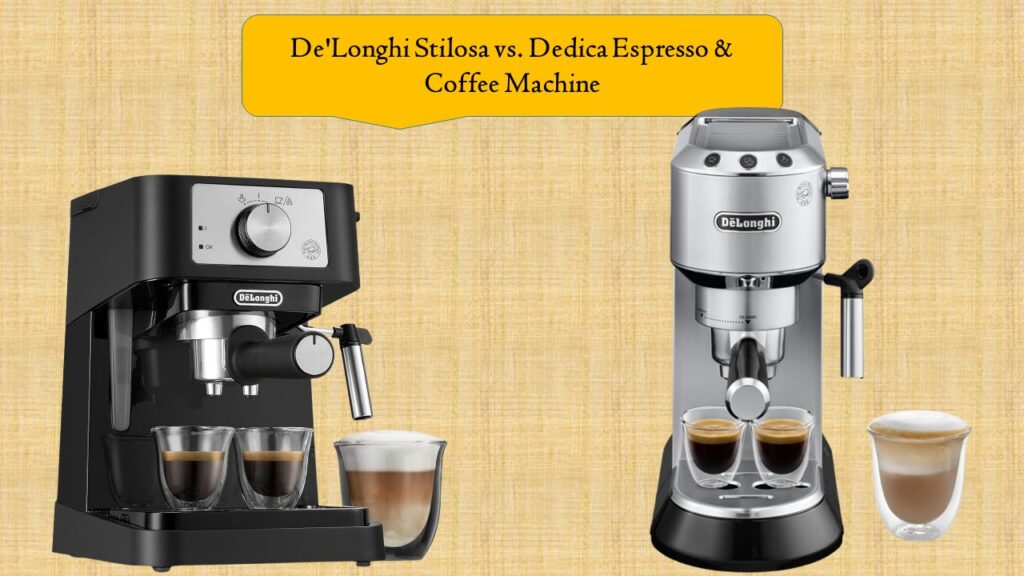

Imagine standing in your kitchen at 7:00 AM, faced with a choice between two gleaming entry-level espresso titans. You aren’t looking for a machine that requires a master’s degree in chemistry to operate; you just want a shot of liquid gold that tastes better than the burnt sludge at the local gas station. This past month, I cleared my counter to make room for the Breville Cafe Roma and the De’Longhi Stilosa.
These two machines represent the gateway to the “real” espresso world—affordable, manual, and strictly no-nonsense. After burning through three bags of beans and steaming enough milk to fill a bathtub, I’ve found that while they both boast 15 bars of pressure, the “feel” of your morning ritual changes drastically depending on which of these silver-and-black beauties you choose.
The Key Difference: Industrial Durability vs. Modern Versatility
The definitive key difference between the Breville Cafe Roma and the De’Longhi Stilosa lies in the build philosophy and the clearance for your favorite mugs. The Breville Cafe Roma is an all-metal throwback; its housing is almost entirely stainless steel, giving it a heavy, professional feel that is rare at this price point. It prioritizes temperature stability through a high-quality Thermoblock system and includes a premium stainless steel frothing pitcher in the box.
The De’Longhi Stilosa, by contrast, is the “modernist” choice. While it uses more plastic in its exterior construction, it solves a major pain point of entry-level machines: the “tall cup” problem. The Stilosa features a two-level cup holder that allows you to remove the drip tray to fit much taller mugs—perfect for those who prefer a large latte over a tiny demitasse. Additionally, the Stilosa utilizes a stainless steel boiler rather than a Thermoblock, which many enthusiasts argue provides better longevity and consistent steam pressure over years of use.
- Note: 1)Too coarse a grind, too little coffee, or insufficiently tamping the grounds before brewing can all lead to...
- Stainless-steel Espresso machine with 15-bar thermo block pump
- Please refer to user guide or user manual or user guide (provided below in PDF) before first use
- Includes Portafilter, measuring scoop/tamper and two filters for single or double espresso
Comparison Table: Breville Cafe Roma vs. De’Longhi Stilosa
| Feature | Breville Cafe Roma (ESP8XL) | De’Longhi Stilosa (EC260BK) |
| Heating System | Thermoblock (Rapid Heat) | Stainless Steel Boiler (Durable) |
| Pump Pressure | 15 Bar | 15 Bar |
| Exterior Finish | Heavy-Duty Stainless Steel | Black Plastic & Stainless Accents |
| Water Tank | 40.6 oz (1.2 L) | 33.8 oz (1.0 L) |
| Cup Clearance | Standard (Fits Espresso Cups) | Two-Level (Fits Tall Mugs) |
| Included Tamper | Plastic Spoon/Tamper Combo | Dedicated Separate Tamper |
| Milk Pitcher | Included (Stainless Steel) | Not Included |
| Filter Baskets | Single, Double, and ESE Pods | Single and Double |
| Warming Plate | Cast Aluminum (Heats 6 cups) | Passive Plastic Top |
| Buy NOW | Buy on Amazon | Buy on Amazon |
Detailed Comparative Review: My First-Hand Experience
Using these two machines back-to-back was a lesson in tactile feedback. In the world of entry-level espresso, “feel” is often just as important as the flavor, because if the machine feels flimsy, you won’t enjoy the process.
Design: The “Tank” vs. The “Trend”
When I pulled the Breville Cafe Roma out of the box, I was immediately struck by the weight. It feels like a miniature version of a commercial machine. The brushed stainless steel isn’t just for show; it makes the machine feel planted on the counter. When I locked in the portafilter, the machine didn’t budge.
The De’Longhi Stilosa has a much more “lifestyle” aesthetic. It’s sleek, it’s matte black, and it looks very 2026. However, it is significantly lighter. I found that I had to hold the top of the machine with one hand while locking in the portafilter with the other to keep it from sliding. That said, the Stilosa’s footprint is slightly more narrow, which my crowded countertop certainly appreciated.
- Note: 1)Too coarse a grind, too little coffee, or insufficiently tamping the grounds before brewing can all lead to...
- Stainless-steel Espresso machine with 15-bar thermo block pump
Ease of Use: Simple Dials vs. Clear Indicators
Both machines are refreshingly simple.
- The Cafe Roma uses a single, chunky dial. Turn it right for espresso, left for steam. It’s impossible to mess up. I loved the “finger loop” on the plug—a classic Breville touch that makes it easy to unplug with one hand.
- The Stilosa uses a similar knob-based system. One thing I preferred on the Stilosa was the “ready” light. It felt a bit more communicative about when the boiler had reached the optimal temperature for steaming.
A major “Ease of Use” win for the Stilosa, however, is the separate tamper. The Cafe Roma comes with a plastic spoon that has a flat bottom for tamping. It’s awkward to hold. The Stilosa comes with a real, dedicated tamper that allows you to apply even pressure much more easily.
- Please refer to user guide or user manual or user guide (provided below in PDF) before first use
- Includes Portafilter, measuring scoop/tamper and two filters for single or double espresso
Functions: Crema and Steam
I put both through a “Crema Test” using the same grind size. Both machines use pressurized (dual-wall) filter baskets. This is great for beginners because it “fakes” a good crema even if your grind isn’t perfect.
- The Cafe Roma produced a very thick, almost frothy crema that lasted until the last sip. The Thermoblock heated up in about 45 seconds, which is incredibly fast for a morning rush.
- The Stilosa took a bit longer to heat up (about 2 minutes), but the steam pressure felt more “honest.” Because it has a real boiler, the steam didn’t sputter as much as the Cafe Roma’s Thermoblock can sometimes do.
Milk Texturing: The Froth Enhancer Debate
The Cafe Roma features a “Froth Enhancer” on the steam wand—a sleeve that pulls in air automatically. It makes it very easy to get big, soapy bubbles for a cappuccino, but it’s harder to get the “wet paint” microfoam needed for latte art.
The Stilosa has a more traditional Panarello-style wand. I found it a bit easier to clean, as the nozzle on the De’Longhi is simple to wipe down. I managed to get a slightly tighter foam on the Stilosa, but it took more practice. If you are a total novice, the Cafe Roma’s wand is more “idiot-proof.”
Breville Cafe Roma Espresso Maker
- Note: 1)Too coarse a grind, too little coffee, or insufficiently tamping the grounds before brewing can all lead to...
- Stainless-steel Espresso machine with 15-bar thermo block pump
Pros:
- Full Stainless Housing: Looks and feels much more expensive than it is.
- Rapid Heating: Thermoblock gets you from “Off” to “Espresso” in under a minute.
- Complete Kit: Includes a high-quality milk pitcher, which saves you $15-$20.
- Large Warming Tray: The top plate actually gets hot enough to warm your cups.
Cons:
- Cup Height: You can really only fit small espresso cups under the spout.
- Combined Tool: The spoon/tamper combo is flimsy and hard to use.
De’Longhi Stilosa Espresso Machine
- Please refer to user guide or user manual or user guide (provided below in PDF) before first use
- Includes Portafilter, measuring scoop/tamper and two filters for single or double espresso
Pros:
- Tall Cup Clearance: The removable tray is a lifesaver for Americano and Latte drinkers.
- Stainless Steel Boiler: Generally more durable over the long term than Thermoblocks.
- Dedicated Tamper: Included in the box for better puck preparation.
- Compact Design: Fits into tighter spaces and looks very modern.
Cons:
- Plastic Feel: Much more plastic in the construction compared to the Breville.
- No Pitcher: You’ll need to buy your own milk frothing jug separately.
The Final Recommendation: My Take
I recommend the Breville Cafe Roma if you appreciate build quality and a classic “heavy” feel. If you are mostly drinking traditional 2-ounce espresso shots or small cappuccinos, the Cafe Roma is a tank that will look beautiful on your counter for years. It’s the better “all-in-one” gift because of the included pitcher and robust metal design.
I recommend the De’Longhi Stilosa if you are a “Mug Person.” If you plan on making lattes in your favorite 12-ounce ceramic mug every morning, the Cafe Roma will frustrate you, while the Stilosa will accommodate you. It is the more practical machine for the modern American coffee drinker who wants a large volume of milk and coffee without the hassle of transferring shots between cups.
In my daily routine, the Breville Cafe Roma wins on pure “soul.” There is something about the weight of the metal and the speed of the Thermoblock that makes the morning feel just a little more premium.
- Note: 1)Too coarse a grind, too little coffee, or insufficiently tamping the grounds before brewing can all lead to...
- Stainless-steel Espresso machine with 15-bar thermo block pump
- Please refer to user guide or user manual or user guide (provided below in PDF) before first use
- Includes Portafilter, measuring scoop/tamper and two filters for single or double espresso
Frequently Asked Questions (FAQs)
Q: Can I use E.S.E. Pods in these machines?
A: The Breville Cafe Roma includes a specific filter basket for pods. The De’Longhi Stilosa is primarily designed for ground coffee, though some users find certain pods can fit in the single-shot basket.
Q: Do I need a special grinder for these?
A: Since both use “pressurized” baskets, they are very forgiving. You can use pre-ground espresso from the grocery store (like Lavazza or Illy) and still get a decent crema.
Q: How do I clean the steam wand?
A: For both machines, you should “purge” the wand by turning on the steam for one second after you’re done frothing, then wipe the exterior immediately with a damp cloth to prevent milk from baking onto the metal.
Q: Is 15 bars of pressure enough?
A: Yes! While “true” espresso is brewed at 9 bars, these home machines use 15-bar pumps to ensure they can push water through the pressurized baskets effectively.