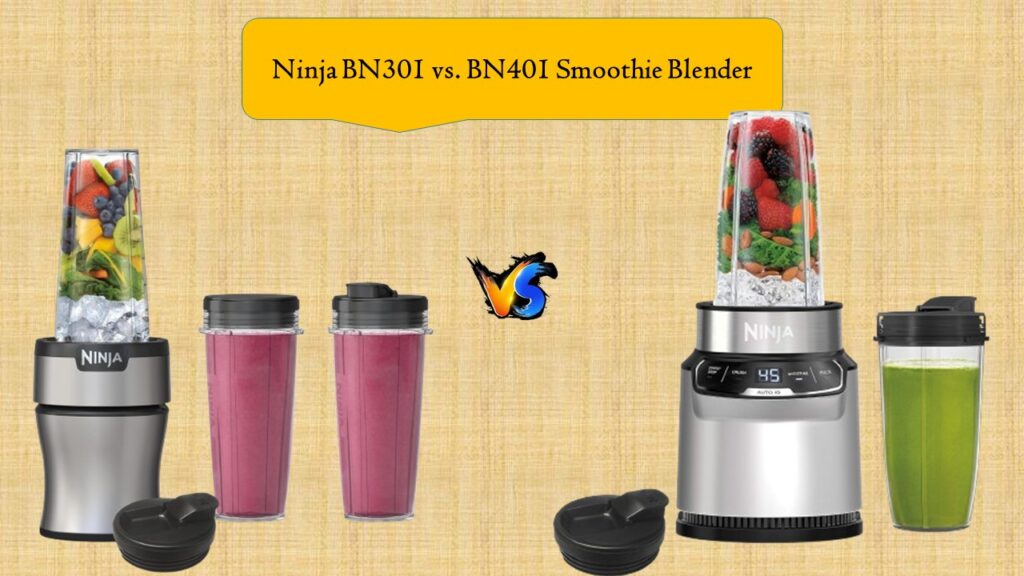
When you spend as much time in the kitchen as I do, you start to realize that the “perfect” blender isn’t always the one with the biggest pitcher or the most buttons. Often, it’s the one that fits into the chaotic five-minute window between waking up and heading out the door. Personal blenders have become the workhorses of the modern kitchen for exactly this reason. They are fast, they are focused, and they minimize the one thing we all hate: cleanup.
Ninja has long dominated this “bullet-style” category, but if you’ve been scrolling through their current lineup, you’ve likely hit a fork in the road between the Ninja BN301 (Nutri-Blender Plus) and the Ninja BN401 (Nutri Pro).
At a distance, they look like twins. Both sport that signature Ninja silver-and-black aesthetic, both use the “cup-inverted” blending method, and both promise to turn a handful of kale and frozen berries into a drinkable liquid in seconds. However, after living with both of these machines on my counter, I’ve found that they represent two very different philosophies of convenience. One is about raw, tactile simplicity, while the other is about “set it and forget it” intelligence.
In this deep dive, I’m going to break down the mechanical nuances, the “vortex physics,” and the daily friction points of both the BN301 and the BN401. This isn’t just about reading a spec sheet; it’s about which motor is going to survive a year of frozen mango chunks and which interface is going to make you less frustrated at 6:30 AM.
Key Difference: The “Brains” vs. The “Brawn”
If you only have thirty seconds, here is the soul of the comparison: The Ninja BN301 is a manual, push-to-blend machine. You are the pilot. You push down on the cup to pulse or hold it for a continuous blend. It’s smaller, comes with more cups (three 20-oz cups), and relies on a 900-peak-watt motor.
The Ninja BN401, on the other hand, is part of Ninja’s Auto-iQ family. It features a digital control panel with two pre-programmed cycles: Smoothie and Crush. You tap a button, and the machine executes a sequence of pulses and pauses designed to let ingredients settle into the blades. It’s also beefier, boasting a 1000-peak-watt motor (though some retail versions in 2026 have been seen at 1100-peak-watts) and larger 24-oz cups.
Comparison Table: BN301 vs. BN401 Blender
| Feature | Ninja BN301 (Nutri-Blender Plus) | Ninja BN401 (Nutri Pro Auto-iQ) |
| Motor Power | 900 Peak Watts | 1000 – 1100 Peak Watts |
| Control Type | Manual (Push-to-Blend) | Digital (Auto-iQ & Manual Pulse) |
| Programs | None (Tactile Pulse) | 2 Auto-iQ (Smoothie, Crush) |
| Included Cups | (3) 20 oz. To-Go Cups | (2) 24 oz. To-Go Cups |
| Lid Types | (2) Spout Lids, (1) Storage Lid | (2) Spout Lids |
| Blade System | Pro Extractor Blades® | Pro Extractor Blades® |
| Footprint | 4.7″D x 4.7″W | 6.3″D x 6.9″W |
| Height | 13.8 inches | 14.3 inches |
| Weight | Approx. 1.3 lbs (Base) | Approx. 4.5 lbs (Total System) |
| Best For | Minimalists, Small Kitchens | Busy Professionals, Frozen Fruit Lovers |
| View Current Price on Amazon | View on Amazon | View on Amazon |
Detailed Comparative Review
Design and Build: The Desktop Footprint
When I first unboxed the BN301, I was struck by how “small” it actually felt. In the world of high-powered blenders, manufacturers usually equate power with bulk. But the BN301 is surprisingly svelte. It has a 4.7-inch diameter, which is roughly the size of a large grapefruit. If you live in a studio apartment or have a kitchen where the “appliance garage” is already overflowing with an air fryer and a coffee station, the BN301 is a ghost – it disappears into corners.
The BN401 feels like a more “serious” piece of machinery. The base is wider and significantly heavier. There’s a reason for this: 1000 watts of power creates a lot of torque. Without that extra weight and the suction-cup feet on the bottom, the BN401 would likely dance across your granite countertop during a heavy ice-crushing cycle.
From an aesthetic standpoint, they both use that “Cloud Silver” finish that Ninja is known for. It’s a high-quality plastic that mimics brushed aluminum. It’s great for hiding fingerprints, which is a major plus when you’re handling it with sticky, fruit-covered hands. However, I noticed the BN401’s digital display gives it a more modern, “techy” vibe, whereas the BN301 looks like a classic, timeless tool.

- 900 PEAK WATT BASE: The intuitive 900-peak-watt push-to-blend motor base powers through everything inside the cup...
- PRO EXTRACTOR BLADES ASSEMBLY: easily crushes ice and breaks down whole fruits and veggies to create nutrient...
- ULTIMATE POWER: 1000-peak-watt motor powers through the toughest ingredients and pulverizes ice to snow in seconds...
- 2 VERSATILE PROGRAMS: 2 Auto-iQ preset programs are uniquely timed for smoothies & crushed ice - remove the...
Ease of Use: Manual Control vs. Automation
Using the BN301 is a very physical experience. There are no buttons. To start blending, you twist the blade assembly onto the cup, flip it over, lock it into the base, and press down. If you want a pulse, you press and release. If you want a smooth blend, you hold it down for 30 seconds.
This is great for people who like to “feel” their blend. If you’re making a chunky salsa, you can precisely control the texture. But here is the catch: you have to stay there. You are the operator. You can’t walk away to grab your keys or check your email while the BN301 is running.
The BN401 completely changed my morning workflow. With the Auto-iQ technology, the machine does the thinking. When I hit the “Smoothie” button, the blender starts a 45-second countdown. It doesn’t just spin at one speed; it pulses for two seconds, pauses to let the frozen strawberries drop into the blades, then ramps up to high speed, then pauses again.
I’ll be honest: at first, I thought “Auto-iQ” was just a marketing buzzword. But after using it, I realized that those pauses are actually doing “vortex management.” In manual blenders, you often get an air pocket around the blade (cavitation), and you have to stop the blender and shake the cup. The BN401’s pulsing pattern prevents that air pocket from forming. It’s a “hands-free” luxury that I found hard to give up.
Performance: The “Frozen Fruit” Test
This is where we get into the “Engineering of the Pulse.” The 900 watts of the BN301 is more than enough for a standard protein shake or a banana-based smoothie. It handles ice well, but you can hear the motor straining slightly when you pack the cup full of frozen mango or hard ice cubes. The texture is good, but if you’re using fibrous greens like kale, you might find a few “confetti” flecks left behind.
The BN401, with its 1000-1100 peak watts, feels like it has an extra gear. It pulverizes ice into what I’d call “resort-quality” snow. If you like those thick, spoonable smoothie bowls, the BN401 is the clear winner. The extra 100-200 watts provides more torque, meaning the blades don’t slow down as much when they hit a hard obstacle.
Both machines use the Pro Extractor Blades®. These are heavy-duty, stainless steel blades that are actually quite blunt to the touch. This is a deliberate design choice. High-speed blenders don’t “cut” food like a kitchen knife; they “pulverize” it using raw speed. The geometry of the Ninja blades is designed to create a “cyclonic” action, pulling ingredients from the top of the cup down through the center.
Functions and Versatility
The BN301 is the “Nutri-Blender Plus.” The “Plus” comes from the accessories. You get three 20-oz cups. This is perfect for a multi-person household where everyone needs their own cup for the gym. It also includes a storage lid, which I used for making small batches of salad dressing or marinades to keep in the fridge.
The BN401 focuses on capacity over quantity. You get two 24-oz cups. That extra 4 ounces might not sound like much, but when you’re trying to fit a handful of spinach, a scoop of protein powder, a cup of frozen berries, and almond milk, that extra headroom prevents the “overflow” mess that happens when you overfill a smaller cup.
One thing I noticed with the BN401 is the “Crush” program. It is specifically tuned for ice. If you’re a fan of frozen margaritas or iced coffees, the BN401 manages the ice-to-liquid ratio much better than the manual pulsing of the BN301.
Maintenance and Longevity
Both machines are “Dishwasher Safe,” but there’s a nuance here. The cups and lids can go on the top rack of any dishwasher without issue. The blade assembly is also dishwasher safe, but I personally recommend hand-washing it. The heat of a dishwasher can eventually degrade the rubber gasket that prevents leaks.
One maintenance issue I’ve seen with the BN301 over time is the “push-to-blend” mechanism. Since you are physically pressing the cup into the base, if you ever have a spill, the liquid can get into the small actuator switches in the base. You have to be diligent about keeping the base clean.
The BN401 has a sealed digital panel. If you spill a bit of smoothie on the buttons, you just wipe it off. There are no “cracks” for the liquid to seep into. However, the BN401 has a more complex motor and a digital motherboard, which theoretically means there are more components that could fail over a five-year period compared to the purely mechanical BN301.
Ninja BN301 (Nutri-Blender Plus) Blender
- 900 PEAK WATT BASE: The intuitive 900-peak-watt push-to-blend motor base powers through everything inside the cup...
- PRO EXTRACTOR BLADES ASSEMBLY: easily crushes ice and breaks down whole fruits and veggies to create nutrient...
Pros:
- Ultra-Compact: Takes up almost no space.
- Value in Accessories: Three cups are better than two for families.
- Tactile Control: You decide exactly how long to blend.
- Lightweight: Easy to move or store in a cabinet.
Cons:
- Manual Effort: You must stand there and press down.
- Smaller Cups: 20 oz can feel cramped for “meal replacement” shakes.
- No Presets: Requires a bit of trial and error to get the perfect texture.
Ninja BN401 (Nutri Pro Auto-iQ) Blender
- ULTIMATE POWER: 1000-peak-watt motor powers through the toughest ingredients and pulverizes ice to snow in seconds...
- 2 VERSATILE PROGRAMS: 2 Auto-iQ preset programs are uniquely timed for smoothies & crushed ice - remove the...
Pros:
- Auto-iQ Logic: True “walk-away” convenience.
- Superior Power: 1000W+ makes shorter work of frozen ingredients.
- Larger Capacity: 24 oz cups are the sweet spot for big smoothies.
- Digital Timer: Lets you know exactly when your drink will be ready.
Cons:
- Larger Footprint: Needs more “real estate” on the counter.
- Louder: The extra power comes with a higher decibel count.
- Heavier: Not as easy to toss in a suitcase for travel.
The “Real World” Experience: Living with the Ninjas
In my week-long test, I noticed things that aren’t on the box. For instance, the noise profile. The BN301 has a higher-pitched “whir.” It’s loud, but it’s a “clean” sound. The BN401 has a deeper, more industrial “growl.” Because it uses Auto-iQ, the noise is intermittent – vroom, silence, vroom, silence. This can actually be more startling to a sleeping roommate than a steady noise.
I also tested the “Leaking under Pressure” factor. When you blend frozen ingredients, they expand slightly. In the 20-oz BN301 cups, I had to be very careful not to cross the “Max Fill” line, or the pressure would force a bit of liquid through the threads. The 24-oz cups of the BN401 gave me more “breathing room,” and I experienced zero leaks, even with “over-packed” ingredients.
Conclusion: Which One Should You Buy?
Choosing between these two comes down to how you value your time and your counter space.
I recommend the Ninja BN301 if: You have a tiny kitchen, you’re on a stricter budget, or you only make “standard” smoothies (fresh fruit, protein powder, milk). It is a reliable, high-quality “no-frills” machine that gives you plenty of cups for the whole family. If you view the “ritual” of pressing down on the blender as a satisfying part of your morning, you’ll love the BN301.
I recommend the Ninja BN401 if: You are a “Power User.” If your smoothies are more like “frozen bricks” of kale, ice, and frozen nut butters, you need the extra torque of the 1000-watt motor. More importantly, if you are someone who is always multitasking – trying to pack a lunch, find your keys, and feed the dog at the same time – the Auto-iQ “walk-away” feature isn’t just a luxury; it’s a necessity. The larger 24-oz cups also make it much more versatile for those who want a “meal in a cup.”
Personally? I’m a fan of the BN401. In the morning, I don’t want to think. I want to press a button, hear the machine do its work, and come back to a perfectly smooth drink. That 45 seconds of “free time” is worth the extra footprint on my counter.
Frequently Asked Questions
1. Are the cups between the BN301 and BN401 interchangeable?
Generally, no. The BN301 uses a 4-tab locking system common to the smaller Nutri-Blender line, while the BN401 uses a wider base design intended for the Auto-iQ series. Always check the model number on the bottom of the cup before buying replacements.
2. Can I make nut butter in these blenders?
You can, but it’s not their primary purpose. Because these are “inverted” blenders, the thick nut butter will stick to the top of the cup, away from the blades. You’ll have to stop, shake the cup, and blend again multiple times. For nut butters, a full-sized blender with a tamper is usually better.
3. Is the BN401 significantly louder than the BN301?
Yes. The 1000-watt motor in the BN401 produces about 92-94 decibels, whereas the BN301 hovers around 88-90 decibels. Neither is “quiet,” but the BN401 definitely has more “authority” (and noise) when it’s running.
4. Does the “Nutrient Extraction” actually mean anything?
“Nutrient Extraction” is Ninja’s term for pulverizing the cell walls of fruits and vegetables. Both machines do this well, but because the BN401 has more power and a dedicated “Smoothie” program, it tends to break down seeds (like those in raspberries or blackberries) more effectively than the BN301.
5. Can I blend hot liquids for soup?
No. Never blend hot liquids in a sealed “bullet-style” blender like these. The steam will create pressure that can cause the cup to explode or the hot liquid to spray out when you open it. Always let your soup cool to room temperature before blending, or use an immersion blender.