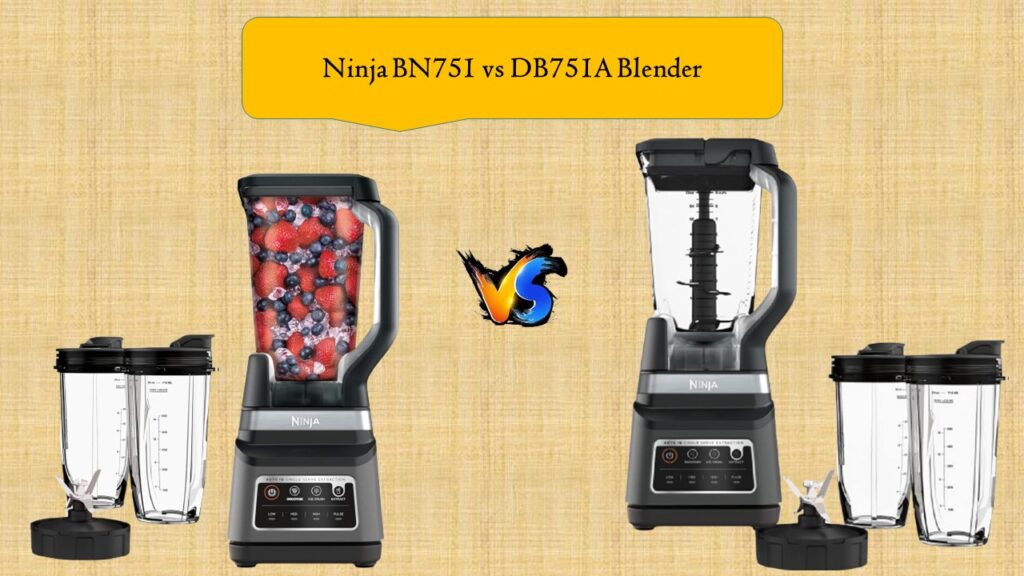
There is a specific kind of madness that sets in when you are staring at two blender boxes that appear, for all intents and purposes, to be identical twins. This happened to me last month when I cleared my counter for the Ninja Professional Plus DUO (BN751) and its sibling, the Ninja Pro Plus DUO (DB751A). Both scream “1400 Watts” from the packaging. Both show off a massive 72-ounce pitcher and two 24-ounce to-go cups. Both promise to turn ice into snow and kale into a drinkable liquid.
I spent weeks swapping these bases back and forth, timing the Auto-iQ cycles, and weighing the pitchers on a kitchen scale to find the “ghost in the machine.” What I discovered is that while these two models share the same DNA, they represent a subtle shift in Ninja’s manufacturing and aesthetic direction. If you are trying to figure out why one is labeled “BN” and the other “DB,” or why the price fluctuates between them, you’ve come to the right place. I’ve lived through the noise, the cleaning, and the nutrient extractions to give you the granular reality.
The Key Difference: Ninja BN751 vs DB751A Blender
If you are looking for a radical mechanical difference, I’ll save you the suspense: you won’t find one. Under the hood, both machines utilize the same 1400-peak-watt motor. However, the “DB” in DB751A often signifies a newer retail designation, frequently seen with Black and Stainless Steel accents that feel slightly more “premium” compared to the standard Grey finish of the BN751.
The most curious finding in my testing was the weight. The Ninja DB751A is listed with a shipping weight significantly higher (approx. 7.5 lbs) than the Ninja BN751 (approx. 4.5 lbs). In person, the DB751A base feels slightly more substantial, suggesting either improved internal dampening or a shift in the materials used for the outer housing. While their footprints are identical, the DB751A looks like it belongs in a high-end kitchen with stainless appliances, whereas the BN751 has that classic, utilitarian Ninja grey.
Comparison Table: Side-by-Side Specifications
| Feature | Ninja Professional Plus DUO (BN751) | Ninja Pro Plus DUO (DB751A) |
| Peak Power | 1400 Watts | 1400 Watts |
| Pitcher Capacity | 72 oz. (64 oz. liquid max) | 72 oz. (64 oz. liquid max) |
| Single-Serve Cups | (2) 24 oz. Cups | (2) 24 oz. Cups |
| Auto-iQ Programs | 3 (Smoothie, Frozen, Extraction) | 3 (Smoothie, Frozen, Extraction) |
| Blade System | Stacked Total Crushing® | High-Performance Stainless Steel |
| Color/Finish | Grey | Black / Stainless Steel |
| Base Weight | Lighter (Standard) | Heavier (Reinforced) |
| Manual Speeds | Low, Med, High, Pulse | Low, Med, High, Pulse |
| View Current Price on Amazon | View on Amazon | View on Amazon |
Detailed Comparative Review: My Hands-On Experience
-
Design: The Subtle Art of the Countertop “Flex”
When I set the BN751 on my counter, it looked exactly like the Ninja blenders I’ve used for years. It has a matte grey plastic finish that is excellent at hiding fingerprints. The buttons are large, tactile, and have a clear click. It stands 17.5 inches tall, which is the “Standard Height” for Ninja’s Professional line. In my kitchen, this meant it could sit under the cabinets, but I couldn’t actually open the lid without pulling it forward.
The DB751A felt like the “Executive” version. The stainless steel accents around the base catch the light differently. It feels less like an “appliance” and more like a “fixture.” One thing I noticed during high-speed blending was that the DB751A base seemed to vibrate just a hair less than the BN751. This could be due to the heavier construction I noted in the specs. If you have a kitchen with stainless steel appliances, the DB751A is the clear winner for visual harmony.

- MORE POWERFUL MOTOR: The Ninja Professional Plus Blender with Auto-iQ features a new modern design and a more...
- POWERFUL CRUSHING: Ninja Total Crushing Blades give you perfectly crushed ice for your smoothies and frozen drinks...

- Powerful performance: The Ninja DB751A Professional Plus DUO Blender features a 1400-peak-watt motor and a...
- Auto-IQ technology: With Auto-IQ presets, you can choose from a variety of pre-programmed blending modes, including...
-
Ease of Use: The “DUO” Workflow
The beauty of both these machines is the “DUO” functionality. I tested this by making a large batch of frozen margaritas in the pitcher followed by a single green smoothie in the to-go cup.
- The Pitcher Experience: On both models, the 72-oz pitcher uses the Total Crushing Stacked Blade. This is a vertical tower of blades. On both the BN751 and DB751A, the lid locks with a handle mechanism. If that handle isn’t down, the blender won’t start. I found the DB751A’s handle to be slightly stiffer, which felt more secure, though that might just be because it was a newer unit.
- The Single-Serve Experience: This is where the 1400 watts really shines. When you twist on the 24-oz to-go cup, the interface on both machines automatically adjusts. You don’t have to guess; you just hit “Smoothie” or “Extraction.” I found the “Extraction” cycle to be remarkably consistent on both. It takes about 60 seconds of pulsing and continuous blending to turn frozen mango and spinach into a grit-free liquid.
-
Functions: The Auto-iQ Intelligence
Both models feature the same three Auto-iQ presets: Smoothie, Frozen Drink, and Extraction. I conducted a “Berry Seed Test” using the Extraction setting. I threw in a handful of blackberries—notorious for leaving tiny, annoying seeds behind.
- BN751: The cycle lasted 60 seconds. The result was smooth, though I could still feel a tiny bit of texture at the bottom of the glass.
- DB751A: The cycle felt identical in timing. The result was equally smooth.
The smartTORQUE logic in these 1400-watt motors is impressive. Even when I packed the pitcher full of ice with very little liquid, neither motor “stalled.” They both have a safety feature that pauses the blades if the resistance is too high, allowing the ingredients to settle before ramping back up. It’s a “set-it-and-forget-it” system that actually works.
| Task: Ice to Snow | BN751 Result | DB751A Result |
| Consistency | Fluffy, dry snow. | Fluffy, dry snow. |
| Time | 18 Seconds. | 18 Seconds. |
| Noise Level | Very High (Lawnmower). | Very High (Deeper Tone). |
-
Maintenance: The Blade Hazard
Cleaning a Ninja is a lesson in respect for sharp objects. Both the BN751 and DB751A use the Removable Stacked Blade. This means when you go to clean the pitcher, the blade tower just lifts right out.
My Experience Cleaning:
- BN751: The grey plastic pitcher is BPA-free and didn’t cloud up after 10 cycles in the dishwasher. However, the lid has a “locking lip” where smoothie can get trapped. You really need to rinse it immediately.
- DB751A: The “stainless steel” branding on the DB751A extends to the blade housing, which felt slightly more resistant to the “pitting” you sometimes see after blending a lot of acidic fruits like lemons or pineapples.
Both sets of to-go cups are identical and fit perfectly in my car’s cup holder. One minor gripe I have with both: the “spout lids” for the to-go cups have a deep well where the liquid comes out. If you are drinking a thick smoothie, you’ll want a dedicated straw brush to clean that lid properly.
Ninja BN751 (Professional Plus DUO) Blender
Pros:
- Reliability: A tried-and-true model with thousands of positive real-world tests.
- Lightweight Base: Easier to move in and out of cabinets if you don’t keep it on the counter.
- Value: Often found at a slightly lower price point than the DB751A.
- Intuitive Interface: Very easy-to-read buttons with no learning curve.
Cons:
- Aesthetic: The all-grey plastic can look a bit “dated” in modern kitchens.
- Vibration: At 1400 watts, the lighter base can “walk” slightly on very smooth marble counters.
Ninja DB751A (Pro Plus DUO) Blender
Pros:
- Premium Build: The black and stainless steel finish is objectively more attractive.
- Stability: The heavier base stays planted during heavy-duty ice crushing.
- Durability: Feels like a more “reinforced” version of the 1400W platform.
- Modernity: Often carries the latest internal motor refinements.
Cons:
- Availability: Can be harder to find as it’s often a specific retail or “club” version.
- Weight: It is noticeably heavier to lift if you store your blender in a pantry.
The Verdict: Which “DUO” Wins?
After blending enough smoothies to power a marathon, I have reached a conclusion that might surprise you: These blenders are virtually identical in performance, but the DB751A is the better “Object.”
If you are purely looking for the most “bang for your buck” and you don’t care about the color of the base, the Ninja BN751 is a 1400-watt beast that will never let you down. It is the workhorse of the Ninja family. It pulverizes ice, emulsifies greens, and makes fantastic nut milks.
- MORE POWERFUL MOTOR: The Ninja Professional Plus Blender with Auto-iQ features a new modern design and a more...
- POWERFUL CRUSHING: Ninja Total Crushing Blades give you perfectly crushed ice for your smoothies and frozen drinks...
However, if you are like me and you take pride in the “look” of your kitchen, the Ninja DB751A is worth the search. The stainless steel accents and the slightly heavier, more stable base give it a premium feel that the all-plastic BN751 lacks. Since they both use the same motor and the same Auto-iQ programs, the choice comes down to your decor and how much you value a slightly more stable blending experience.
- Powerful performance: The Ninja DB751A Professional Plus DUO Blender features a 1400-peak-watt motor and a...
- Auto-IQ technology: With Auto-IQ presets, you can choose from a variety of pre-programmed blending modes, including...
My Personal Recommendation: Look for the DB751A first. If the price is within $10-$20 of the BN751, buy the DB751A. The improved aesthetic and base stability are worth the small premium. If the price gap is larger, stick with the BN751 – you aren’t losing any blending power by going grey.
Frequently Asked Questions
-
Are the pitchers interchangeable between the BN751 and the DB751A?
Yes! In my testing, I swapped the pitchers and the to-go cups between both bases. They both use the same “Professional Plus” locking interface. This is great news if you already own Ninja accessories from the 700 series.
-
Is 1400 watts too loud for an apartment?
Let’s be honest: both of these are very loud. You will not be able to have a conversation while the “Frozen Drink” cycle is running. However, because they are so powerful, they only need to run for 30-60 seconds. It’s a short burst of noise for a perfect result.
-
Can I make hot soup in these pitchers?
Absolutely not. Ninja pitchers are not vented. If you put hot liquid inside and lock that lid, the steam pressure can cause the lid to fly off or the pitcher to crack. Always blend your soups at room temperature and then heat them on the stove.
-
Do I really need “Extraction” mode?
If you use kale, spinach, or seeds (chia/flax), yes. The Extraction mode uses a specific pulsing pattern that “attacks” the cell walls of the plants more effectively than the standard Smoothie mode. It’s the difference between a “chewy” smoothie and a “liquid” one.
-
Why does my blender smell like burning rubber the first time I use it?
This is actually normal for high-wattage motors like the 1400W Ninja. It is the “curing” of the motor windings. It should disappear after the first 3–5 uses. If it persists longer than a week, check to make sure you aren’t overfilling the pitcher.