The kitchen counter has officially become a high-stakes laboratory over the last month as I’ve been juggling the Ninja DCT451 and the Ninja DCT651. If you’ve ever tried to roast a whole chicken while simultaneously attempting to bake a delicate tray of cookies, you know the geographical struggle of a single-cavity oven. Ninja’s “Double Oven” series aims to solve this with their FlexDoor technology, effectively splitting one appliance into two independent cooking zones.
Having lived with both of these stainless steel powerhouses, I’ve realized that while they look almost identical sitting on the shelf, the experience of using them specifically how they handle temperature precision and countertop real estate – reveals two different philosophies. One is a smart essential for the busy family, while the other feels like a “Pro” iteration designed for those who demand surgical precision with their proteins.
The Key Difference: Pro Cook Intelligence vs. Smart Cook System
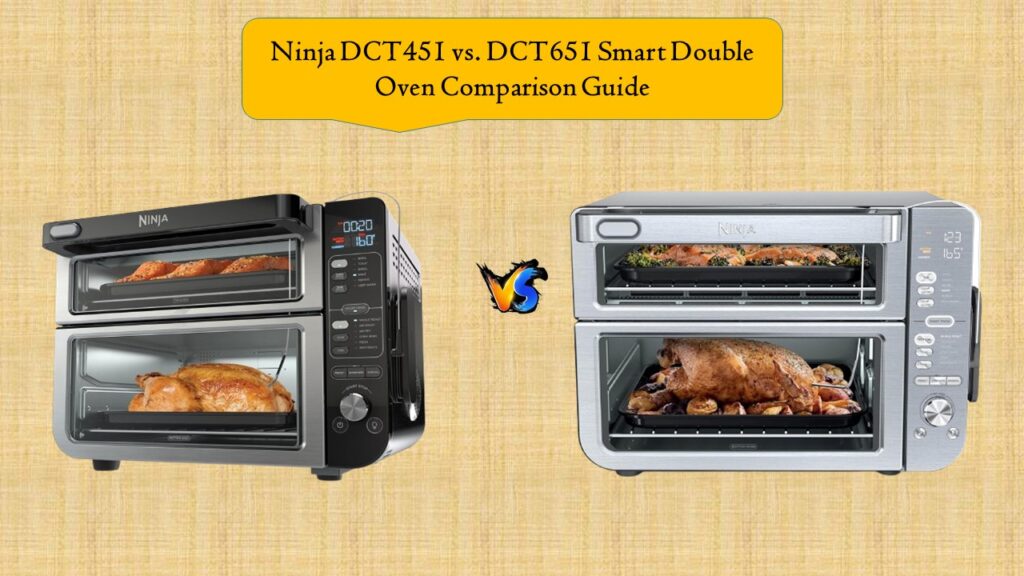
The primary distinction between the Ninja DCT451 vs DCT651 lies in the Depth Profile and the Thermometer Intelligence.
- The Ninja DCT651 (The Pro XL): This model features the Pro Cook System with “Auto Temp Detect Intelligence.” It is designed to be more intuitive for specific doneness levels (rare to well done) at the touch of a button. Interestingly, it also features a shallower depth profile ($18.6″$), making it sit more flush with standard kitchen counters.
- The Ninja DCT451 (The Smart Double Oven): This unit utilizes the Smart Cook System. While it still includes a leave-in thermometer for precise monitoring, it lacks the specific “Pro” auto-detection presets found in the 651. It also has a deeper footprint ($21.5″$), requiring more clearance behind the unit for ventilation.
In short: You are choosing between the deeper, high-capacity Smart system (DCT451) and the sleeker, more intelligent Pro Cook system (DCT651).
Comparison Table: Ninja DCT451 vs. DCT651
| Feature | Ninja DCT451 (Smart) | Ninja DCT651 (Pro XL) |
| Technology | Smart Cook System | Pro Cook System (Auto Temp Detect) |
| Door Type | FlexDoor (Split or Full) | FlexDoor (Split or Full) |
| Functions | 12-in-1 (Dual Zone) | 12-in-1 (Dual Zone) |
| Thermometer | Included (Leave-in) | Included (Pro-Grade Leave-in) |
| Depth | 21.5″ (Deeper Profile) | 18.6″ (Slimmer Profile) |
| Width | 16.39″ | 16.39″ |
| Height | 13.26″ | 13.26″ |
| Finish | Stainless Steel | Stainless Steel |
| FlavorSeal | Yes (No smell transfer) | Yes (No smell transfer) |
| Capacity | 6 lbs Wings + 12″ Pizza | 6 lbs Wings + 4.5 lb Chicken |
| View Current Price On Amazon | View on Amazon | View on Amazon |
Detailed Comparative Review: First-Hand Kitchen Stress Tests
-
Design: The Battle of the Countertop Inch
When I first unboxed the DCT451, I was struck by its depth. At 21.5 inches deep, it is a significant piece of hardware. I had to rearrange my coffee station just to ensure the back vents weren’t blasting my espresso machine.
On the flip side, the DCT651 felt like it was designed by someone who actually lives in a modern kitchen. That nearly 3-inch difference in depth ($18.6″$) is massive. It sits back comfortably against the backsplash without overhanging the front of the counter. Both machines share the brilliant FlexDoor. There’s a small latch on the handle; push it, and only the top oven opens (perfect for toast or bagels). Pull the whole handle, and both cavities are exposed. It’s a mechanical marvel that feels sturdy and premium in both models.

- FLEXDOOR: Creates two separate ovens. Access just the top for quick meals and snacks, or open the full door so you...
- FLAVORSEAL TECHNOLOGY: Two separate ovens prevents smells from crossing between ovens, so your flavors stay...

- SMART FINISH with DualZone Technology: Sync both independent ovens to cook 2 meals, 2 different ways that finish at...
- FLAVORSEAL TECHNOLOGY: Two separate ovens prevents smells from transferring between ovens, so your flavors stay...
-
Ease of Use: Programming the Perfect Finish
The learning curve for these ovens is surprisingly shallow. Both feature Smart Finish technology, which is the “holy grail” for dinner timing.
In my testing with the DCT651, I put a tray of salmon fillets in the bottom and asparagus in the top. I programmed the salmon to finish at “Medium” using the Pro Cook thermometer. I set the asparagus to “Air Roast.” By hitting the Smart Finish button, the oven delayed the start of the asparagus so that both the fish and the veggies were piping hot at the exact same second.
The DCT451 performs the same magic, but the interface on the 651 felt a bit more “automated.” With the 451, I was setting specific temperatures manually based on the thermometer’s reading. With the 651’s Auto Temp Detect, I just selected “Rare” for a tri-tip, and the machine handled the rest.
-
Functions: 12-in-1 Versatility
Both ovens are split into two distinct zones:
- The Top Oven: This is the “Rapid Oven.” It’s designed for high-speed, direct heat. This is where I did all my toasting, bagel browning, and broiling. It heats up almost instantly because the cavity is so small.
- The Bottom Oven: This is the “Convection & Air Fry” powerhouse. This is where the heavy lifting happens – air frying 6 lbs of wings, roasting a whole chicken, or baking a 12-inch pizza.
One Saturday, I used FlavorSeal to its full potential. I was air frying garlic-heavy wings in the bottom while baking a tray of cinnamon rolls in the top. In a standard oven, those rolls would have tasted like garlic. Thanks to the separate seals in these Ninja units, the cinnamon rolls remained sweet and untainted. Both the 451 and 651 passed this test with flying colors.
-
Maintenance: The Crumb Tray Struggle
Let’s be honest: countertop ovens are crumb magnets. Both units feature a removable crumb tray at the very bottom, which is easy enough to slide out.
However, because the DCT451 is deeper, cleaning the back corners of the interior is a bit of a reach. The DCT651, being shallower, was much easier to wipe down. The stainless steel exterior on both is high quality, but like all Ninja products, they are susceptible to fingerprints. A quick wipe with a microfiber cloth keeps them looking “showroom ready,” but you’ll be doing it often. The wire racks and air fry baskets are dishwasher safe, though I recommend hand-washing the sheet pans to keep the nonstick coating from degrading.
Ninja DCT451 Smart Double Oven
- FLEXDOOR: Creates two separate ovens. Access just the top for quick meals and snacks, or open the full door so you...
- FLAVORSEAL TECHNOLOGY: Two separate ovens prevents smells from crossing between ovens, so your flavors stay...
Pros:
- Massive Internal Volume: The extra depth allows for larger, awkward-shaped baking dishes.
- Smart Finish: Perfectly synced meals every time.
- Price Point: Generally more accessible than the Pro model.
- FlexDoor: Extremely convenient for quick snacks without heating the whole house.
Cons:
- Footprint: Very deep; might not fit on shallow counters.
- Manual Precision: Requires a bit more “chef’s intuition” compared to the Pro Cook system.
Ninja DCT651 (Pro XL Double Oven) Air Fryer Toaster Oven Combo
- SMART FINISH with DualZone Technology: Sync both independent ovens to cook 2 meals, 2 different ways that finish at...
- FLAVORSEAL TECHNOLOGY: Two separate ovens prevents smells from transferring between ovens, so your flavors stay...
Pros:
- Counter-Depth Design: Sits flush and looks more integrated into the kitchen.
- Pro Cook System: The auto-doneness presets are incredibly accurate for meat.
- Advanced Thermometer: The “Auto Temp Detect” intelligence is a massive time-saver.
- Smart Finish & Dual Zone: The most advanced syncing logic available from Ninja.
Cons:
- Price: It sits at the top of the price bracket.
- Internal Limits: The shallower depth means you have to be careful with very long roasting pans.
The Verdict: Which Double Oven Wins?
After a month of back-to-back roasting, my choice is dictated by the layout of your kitchen.
I recommend the Ninja DCT451 if: You have deep, farmhouse-style counters and you frequently cook for large crowds where every cubic inch of space matters. If you don’t mind manually setting your target temperatures for the thermometer, this unit gives you the same 12-in-1 power and FlavorSeal technology at a better value.
I recommend the Ninja DCT651 if: You want the pinnacle of countertop cooking technology. That 18.6-inch depth is a lifesaver for standard kitchens, and the Pro Cook System makes it nearly impossible to overcook a steak or chicken. It is the “smarter” of the two machines and fits more elegantly into a modern home.
My Personal Choice: I’m keeping the Ninja DCT651. The shallower footprint makes my kitchen feel much less cluttered, and the “Auto Temp Detect” takes the anxiety out of cooking expensive cuts of meat. It’s the ultimate “set it and forget it” machine.
Frequently Asked Questions
-
Does “Double Oven” mean I can use two different temperatures?
Yes! That is the beauty of the DCT series. You can have the top oven at 450°F for broiling and the bottom oven at 325°F for slow roasting. They are completely independent.
-
Is it hard to clean between the two ovens?
The divider between the two ovens is fixed, but there is a seal where the FlexDoor meets it. I found that occasionally crumbs get caught in that middle seal, but a quick vacuum attachment or a damp cloth clears it out easily.
-
Can it really replace my full-size oven?
For about 90% of meals, yes. Unless you are roasting a 20-lb turkey for Thanksgiving, these ovens have enough capacity for 6-lb chickens, full pizzas, and large sheet pan meals. They also preheat significantly faster than a traditional oven.
-
How loud is the convection fan?
It is noticeable, especially on the “Air Fry” or “Whole Roast” settings where the fan is at high speed. It’s similar to a microwave running. The top oven is virtually silent as it doesn’t use a heavy convection fan.
-
Can I open the top door without heat escaping from the bottom?
Absolutely. The FlexDoor is designed so that the top door can open independently. The bottom oven remains sealed, maintaining its temperature and preventing your air fry cycle from being interrupted.